

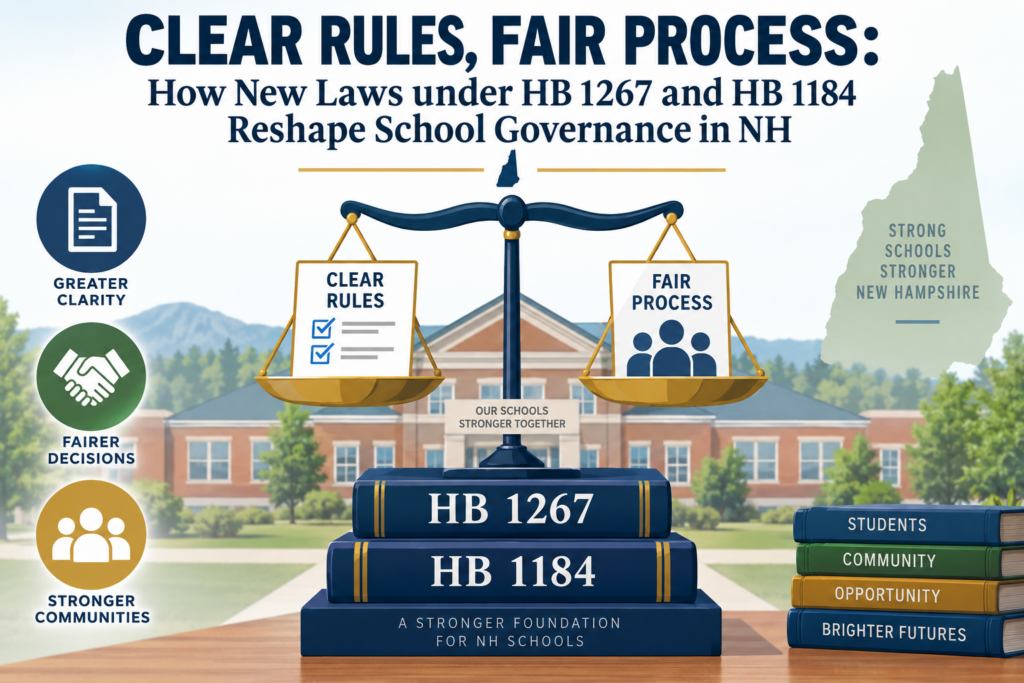
New Hampshire lawmakers sent a clear message this year about the importance of fair, transparent school governance when they overwhelmingly overrode Gov. Kelly Ayotte’s vetoes of two education and governance related bills: HB 1267 regarding the secret questioning of students by non-school personnel and HB 1184 regarding no trespass orders on public properties.
On August 19, 2026, the House voted 311–6 to override the veto of HB 1267, while the Senate voted 24–0. The House then voted 290–29 to override the veto of HB 1184, with the Senate again voting unanimously 24–0. Both bills therefore became law without the governor’s signature under our constitutional system of checks and balances.
The bi-partisan margins were striking. A two-thirds vote in both chambers is required to override a gubernatorial veto, yet HB 1267 received nearly unanimous support in the House and Senate, and HB 1184 also received substantially more than enough votes to become law.
Where HB 1267 came from
HB 1267 grew out of concerns raised by parents and school board advocates about students being questioned at school without their parents knowing in advance.
Rep. Vanessa Sheehan (R-Milford), the bill’s prime sponsor, said she filed the legislation after students at Milford Middle School were asked to provide statements concerning a teacher’s conduct. According to the account presented to lawmakers, the students’ parents wanted to know beforehand but were not notified and were not present. Sheehan told the Senate Education Committee that although legislation is not always the best solution to a single incident, she believed HB 1267 would have prevented that situation had it already been law.
The bill was developed by the School District Governance Association of New Hampshire (SDGA-NH), which is an organization advocating for greater parent and citizen involvement in school district governance. Rep. Sheehan introduced HB 1267 with eight additional House sponsors.
The final law requires school boards and chartered public-school trustees to establish a written policy governing the questioning of minor students by non-school personnel and certain school employees. The policy must prohibit questioning a minor without express prior written permission from a parent or guardian. It specifically covers attorneys, paralegals and law-enforcement personnel, including individuals in those professions who may be employed by a school district or SAU.
HB 1267 also gives parents and guardians the right to be present when their child is questioned and the right to have their own attorney present. For adult students, the student is asked whether the student wants the parents notified and given an opportunity to attend. The law also provides a legal remedy for parents or guardians who believe their rights have been violated. There is an important exception for legitimate child welfare inquiries conducted by DCYF or law enforcement under RSA 169-C. On veto day, Rep. Katy Peternel (R-Wolfboro), speaking on the House floor in support, stated that HB 1267 increases trust between parents and school districts when everyone clearly knows the policies, that they are fair, and that they are backed up by state law. HB 1267 takes effect January 1, 2027.

HB 1184: Fair process for no trespass orders
HB 1184 addresses a different but related problem: what happens when a public official issues a no trespass order (NTO) against a person on public property, including municipal or school district properties.
The bill’s six House and one Senate sponsors, led by Rep. Juliet Harvey-Bolia (R-Tilton), sought to establish a statewide process for issuing, extending and appealing NTOs on municipal and school property. This bill was also initiated by SDGA-NH to address inconsistent and what appears to be sometimes unfair use of NTOs without due process. As Rep. Diane Pauer (R-Brookline), a co-sponsor of the bill, argued on the House floor during veto day, currently “It’s the wild west.”
The legislation encountered substantial opposition during the process. Law enforcement, municipal, school board, library, and county organizations raised practical concerns about earlier versions, particularly short deadlines for public bodies to review emergency orders. Those concerns resulted in significant commonsense changes in the House and Senate committees, and continued during a bi-partisan and bi-cameral Committee of Conference to make important amendments before final passage, before the veto and veto override. Emergency orders were given a longer period, the process was changed to use the next regularly scheduled meeting, and the final legislation established procedures for longer term orders.
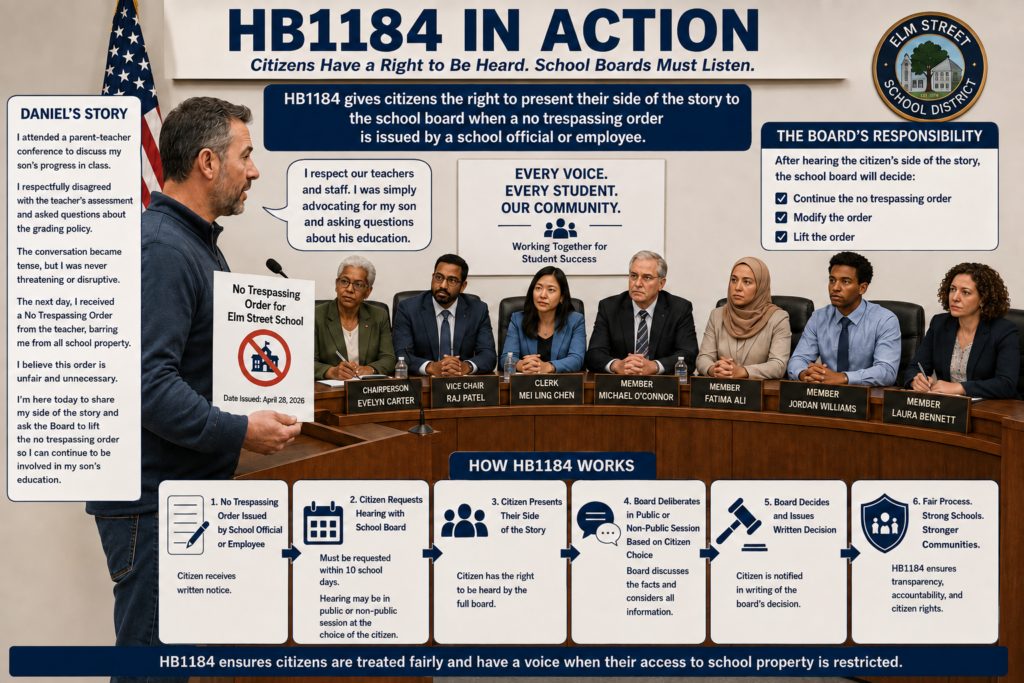
The final HB 1184 creates procedural safeguards for people subjected to NTOs. It establishes a process for issuing emergency 35-day NTOs by governing body designated individuals, along with the process of extending public property NTOs via a vote of the governing body, and gives affected individuals a right to a hearing and appeal. Existing NTOs as of the effective date of the law (October 18, 2026) must also be reviewed by the governing body within 90 days; an order that is neither properly reissued nor rescinded becomes void.
The law does not eliminate the ability of public officials to protect students, employees or the public. Instead, it establishes a fair process for balancing safety with individual rights. Following a hearing, the governing body must vote and issue a written decision stating whether the NTO is rescinded, modified or continued for a defined period, limited to a year maximum. A person affected by the decision may appeal to superior court within 30 days.
That is the central principle behind HB 1184: a person can be excluded from public property when there is a legitimate reason, but there should also be a reasonable process for challenging that decision. This process also ensures that school boards and other governing bodies are aware of and support the issuance of such NTOs.
Our state is now a national leader in this area – New Hampshire is the first state in the nation to adopt a single, comprehensive statute governing NTOs across all public property – municipal, school district, county, state, and public universities – with a clear issuance process and an independent appeal to the governing body. Most states offer no local redress at all, and those that do have narrow, siloed laws: South Carolina §16‑11‑625 applies only to libraries, Texas §37.105 only to K-12 schools, and California §626.4 only to K-12 schools and public universities, with appeals routed back to the same administrator who issued the order. New Hampshire’s unified, due‑process‑based model is unprecedented nationally and sets a new standard for fair, accountable public property governance.
Two laws, one approach to better governance
HB 1267 and HB 1184 deal with different circumstances, but they share an important governing principle: public institutions should operate under clear, fair policies rather than informal or arbitrary practices.
HB 1267 protects students and parents by establishing statewide rules against secret questioning of minor students by covered non-school personnel without prior written parental permission. It puts parental rights into a written policy requirement backed by state law.
HB 1184 similarly puts guardrails around the use of NTOs on public property, including school property. It preserves the authority to act when safety requires immediate action while providing notice, review, a hearing, a written decision and an avenue of appeal.
Together, these laws strengthen school governance by moving important decisions out of an uncertain gray area and into clear, consistent procedures backed by state law.
SDGA members believe good school governance is not simply about giving school officials more authority or giving parents more authority. It is about establishing reasonable rules so everyone understands the process, knows their rights, and can expect those rules to be followed.
HB 1267 says parents should not have to discover after the fact that someone questioned their minor child. HB 1184 says a person should not lose access to public property indefinitely without a reasonable opportunity to challenge the decision.
Both laws therefore advance a straightforward principle: protect students, respect parents, preserve legitimate school authority—and make sure government decisions are governed by fair, transparent rules.
Eric Pauer serves as the President of the School District Governance Association of NH (SDGA-NH, https://www.sdganh.org). He is a former member of the Hollis Brookline Cooperative School Board and resides in Brookline.