
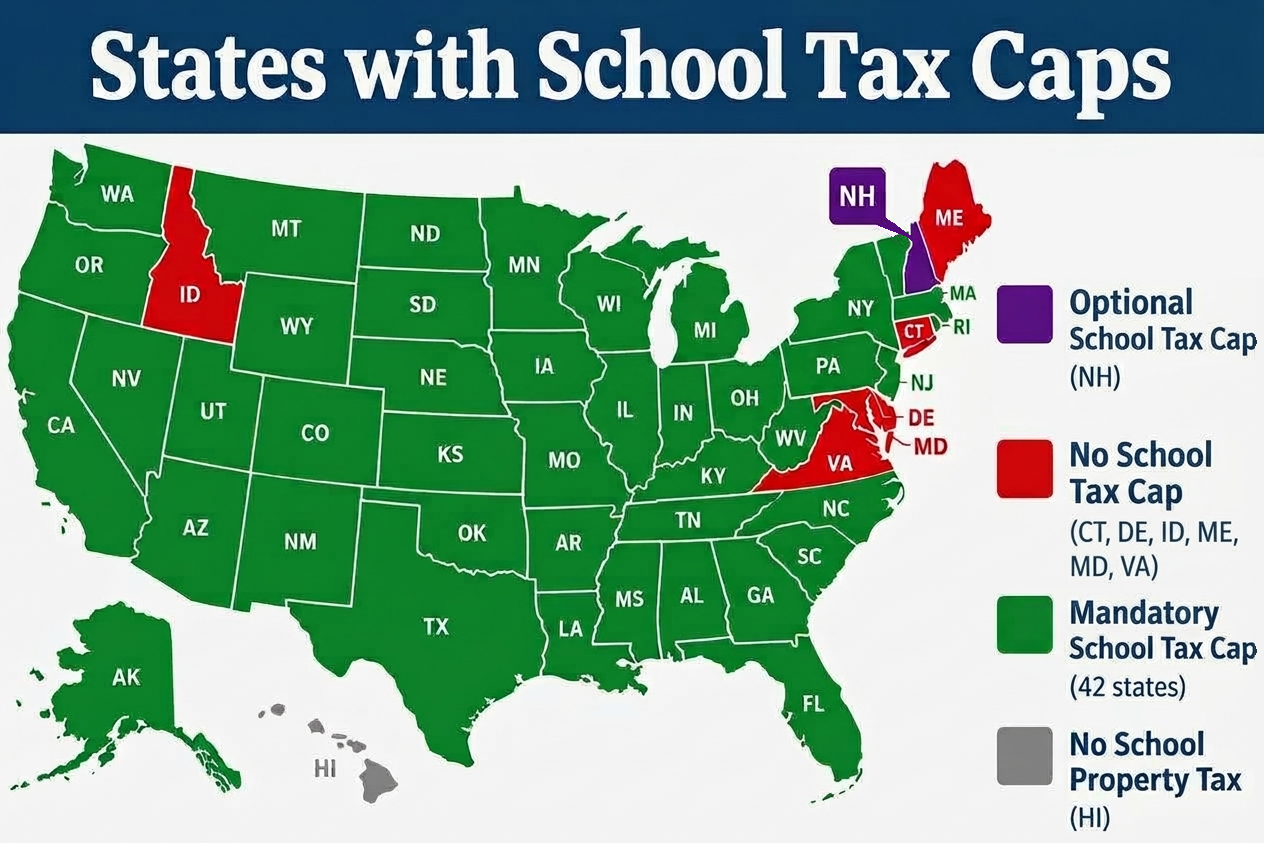
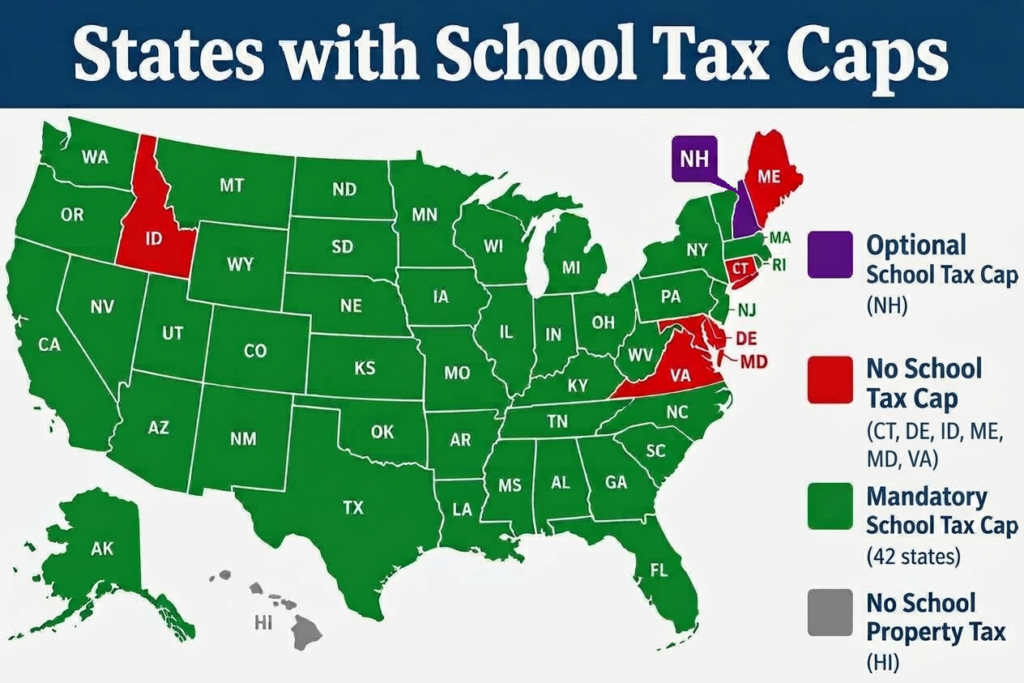
Many school boards, administrators, and pro-spending organizations claim that Question 2—the optional school tax cap on the November 3 ballot—will spell the end of public education in New Hampshire. That claim is an exaggeration! Among the 49 states that use property taxes to fund schools, 42 have some form of mandatory cap on school taxes or school budgets. New Hampshire is one of only seven states in that group without a mandatory cap. Under HB 1300, New Hampshire’s optional cap takes a light-touch approach, offering a guardrail against rapid increases in school property taxes.
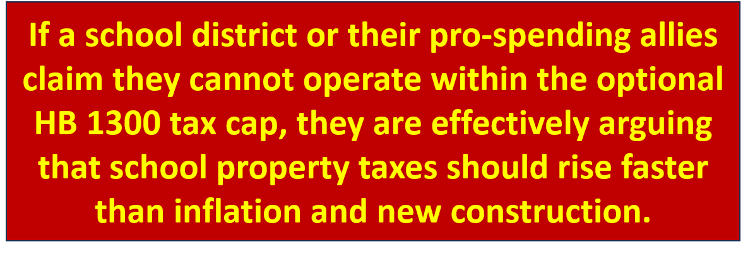
If a school district or their pro-spending allies claim they cannot operate within the optional HB 1300 tax cap, they are effectively arguing that school property taxes should rise faster than inflation and new construction—even as student enrollment declines. Their message to taxpayers? Pay up!
On November 3, every New Hampshire ballot will include Question 2, which asks voters whether to “limit property tax growth” for their school district. The optional cap will not cut school funding; if adopted, it will limit the rate at which school property taxes can increase for next two years.
What Question 2 on the November 3 ballot does
If adopted for a two-year period by a three-fifths (3/5) majority, the local property tax levy (tax effort) cannot grow beyond the prior year’s amount, adjusted for inflation and new construction, and SAU central-office spending could not exceed 6 percent of total school district appropriations, not classroom instruction or school-based services. Bonded capital costs for school buildings are be excluded from both limits
Local control remains: a three-fifths vote at the annual meeting can override either cap. Beyond this override, additional safeguards address urgent needs. With the Commissioner of Education’s approval, a school board may spend beyond its appropriation when unusual circumstances arise, though it may not raise the tax rate through that process (RSA 32:11). In an emergency, the Superior Court may authorize a special school district meeting (RSA 197:3).
New Hampshire is an outlier on school tax caps—and HB 1300 is a first step
The School District Governance Association of New Hampshire (SDGA-NH) researched how other states limit school taxes or budgets; the accompanying table summarizes the findings. Hawaii does not have a property tax to fund schools. Of the remaining 49 states, 37 have a statewide mandatory cap on school taxes or school budgets. Five more have mandatory caps that apply to most of the state or to part of the school tax. In total, 42 of the 49 states have some form of mandatory school tax cap. Only seven have no mandatory cap at all: Connecticut, Delaware, Idaho, Maine, Maryland, New Hampshire, and Virginia.
Other New England and nearby states also limit tax growth. Massachusetts’ Proposition 2½ generally limits annual growth in a town’s tax levy to 2.5 percent, plus new growth. New York limits school-levy growth to 2 percent or inflation, whichever is lower; exceeding the limit requires 60 percent voter approval. New Jersey generally limits school-levy growth to 2 percent, subject to adjustments, while Rhode Island limits city and town levy growth to 4 percent. Vermont imposes a local penalty paid to the state equal to tax effort above its state-mandated cap—effectively a 100 percent penalty on the excess.
HB 1300: A light-touch approach to tax caps
New Hampshire’s approach is among the lightest possible: no other state leaves school tax caps entirely to local option. HB 1300 is uniquely flexible because it leaves the choice entirely to local voters as a two-year trial. Question 2 puts this choice directly before voters on the November ballot, when turnout is generally higher than at March or May annual meetings.
Why it matters
In many towns, school taxes account for 60 to 80 percent of a property tax bill, according to New Hampshire Department of Revenue Administration 2025 tax-rate data. Since 2000, public-school enrollment has fallen from 208,461 to 160,322—a decline of about 48,000 students—according to NCES and the New Hampshire Department of Education. Yet school spending continues to rise. The proposed cap will start with the amount each district raises today and allow that amount to grow with inflation and new construction. In its October 10 editorial endorsing Question 2, the Union Leader said the cap “keeps budgets from growing faster than taxpayers’ ability to pay.”
Question 2 is a modest, optional, and temporary step toward more sustainable property taxes. It is not the end of public education; instead, it is a commonsense guardrail against unsustainable property tax increases, aligning us with a practice used in the vast majority of other states.
On November 3, vote YES on Question 2 to adopt the tax cap.
Eric Pauer serves as the President of the School District Governance Association of NH (SDGA-NH, https://www.sdganh.org). He also represents SDGA-NH on the 2026 SB 574 Legislative Commission currently studying the efficiency and structure of school administrative units (SAUs). He is a former member of the Hollis Brookline Cooperative School Board, and resides in Brookline.